“Remember friends as you pass by, As you are now so once was I. As I am now, so you must be; Prepare yourself to follow me.”
– Anonymous, 18th-century epitaph, commonly found in early American and British graveyards
To study the past is to depend on the dead.
We handle their possessions, rebuild their homes, display their bones. The historical imagination depends upon this intimate trespass: that the way to understand another human being is to disturb their rest. It is an act both devotional and extractive — archaeology as a theology without a god. This contradiction is not new, but the conditions of visibility have changed.
Want to read more? Subscribe to follow the project and its ongoing conversations.
In Britain alone, tens of thousands of human remains are stored in museums. The Oxford University Museum of Natural History, the British Museum, and the Museum of London together hold enough individuals to populate a small town. Most remain in drawers; others are digitised, modelled, reconstructed — and thus made infinitely reproducible. The dead, once local and particular, now circulate through data infrastructures that collapse geography and context. A single skeleton might exist simultaneously as dataset, Instagram post, and 3D print.
The transformation of human remains into endlessly replicable images raises a problem more subtle than the old debate over repatriation or display: what kind of epistemology does this new visibility produce?
The Epistemic Violence of Curiosity
Every discipline has an origin myth. For archaeology, it is curiosity redeemed by method.
The early antiquarians of the seventeenth and eighteenth centuries — men like William Stukeley or Giovanni Belzoni — approached the past as spectacle. Their fascination was emotional, almost religious, and their transgressions were obvious: tomb-robbing, the shipment of mummies to London drawing rooms, skull collections treated as travel souvenirs. Professional archaeology arose as an ethical corrective to such excess.
Yet even in its modern, regulated form, the discipline depends on the same impulse: curiosity that transforms the private into the knowable. As Michel Foucault observed in The Order of Things (1966), classification is never innocent — it creates the objects it claims to describe. By reconstituting the dead as data, we simultaneously efface their personhood and secure our authority to interpret them.
This is what philosopher Gayatri Spivak would call epistemic violence: the production of knowledge through silencing. The excavation trench, the conservation lab, the exhibition case — all are theatres in which disturbance is renamed discovery. Curiosity may be the archaeologist’s animating virtue, but it remains morally asymmetrical: the living question, the dead cannot refuse.
Consent Beyond the Grave
Western jurisprudence treats death as a threshold that ends consent. Yet the persistence of funerary law, repatriation ethics, and the language of “ancestral remains” demonstrates that social personhood does not dissolve at the moment of biological death.
The Human Tissue Act (UK, 2004) recognises this paradox implicitly, requiring “appropriate consent” for modern remains but exempting those older than 100 years — a chronological distinction masquerading as an ethical one.
Why does temporal distance nullify obligation? Archaeologists often argue that very ancient remains fall outside living memory and thus outside moral community. But this view collapses when tested cross-culturally: Māori, Indigenous Australian, and many African traditions conceptualise ancestry not as linear distance but as co-presence. To exhume a body — even a millennium old — can therefore still violate a social contract of kinship.
If we follow Emmanuel Levinas’s notion that ethics begins in the recognition of the Other’s face, then the digital reconstruction of an Iron Age woman’s visage is not morally neutral. It reconstitutes the face without restoring the voice. The act of reanimation risks substituting simulation for relationship — an encounter staged for us, not with us.
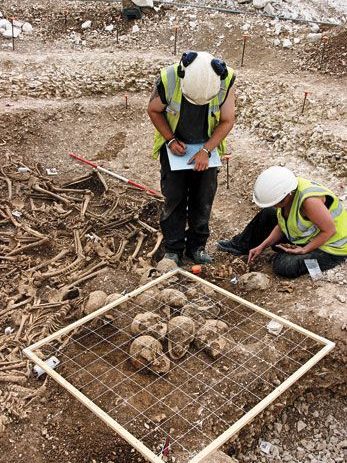
Excavation photograph from a Viking burial site. Image from David Keys, “A Viking Mystery,” Smithsonian Magazine (2010).
The Genealogy of Display
The modern museum inherits several overlapping logics of seeing the dead: devotion, pedagogy, and spectacle. Medieval reliquaries made sanctity visible through material fragmentation. A saint’s femur encased in crystal invited pious contemplation, yet also aestheticised the fragment. By the Renaissance, anatomy theatres such as Padua’s (1594) transformed dissection into public ritual: scientific illumination framed as moral instruction. The Enlightenment extended that gaze to empire — the skull as instrument of racial taxonomy.
Each epoch produced its own justification for visibility, yet all shared an underlying assumption: that the dead exist for the edification of the living.
The post-colonial museum still operates within this genealogy, even as its rhetoric shifts from ownership to stewardship.
The digital turn radicalises this inheritance. Where the reliquary localised, the screen disseminates.
An excavated skeleton posted to X (formerly Twitter) is not a display but a broadcast — stripped of its physical context and moral frame. The same image oscillates between research and recreation, accumulating likes instead of liturgical reverence.
Spectacle is not in itself unethical; as Susan Sontag argued in Regarding the Pain of Others (2003), to see suffering — or in this case mortality — is sometimes necessary for moral awareness. Yet spectacle without framing breeds consumption, not reflection. To scroll past the dead is to normalise them as content.
The Archaeology of Seeing
Looking is a cultural act.
John Berger’s Ways of Seeing (1972) taught that the gaze is structured by power; archaeology extends that principle temporally. To look at the dead is to assert a hierarchy of time: the living interpret, the dead are interpreted.
Modern archaeology formalises this hierarchy through the rhetoric of objectivity. A burial becomes a “feature,” a skeleton a “context,” a person a “specimen.” Such language performs a subtle alchemy: the subject becomes object, then data. Scientific precision, as Donna Haraway reminds us, is never free from the “god trick” — the illusion of neutral, disembodied vision.
The shift from excavation to digital mediation compounds this abstraction. Three-dimensional scanning and photogrammetry promise “non-invasive” access, yet they perpetuate the logic of exposure. A rendered skull may preserve its physical integrity, but it multiplies its visual vulnerability. The ethics of excavation have been externalised into the ethics of image production.
The result is a new form of archaeological modernity, where preservation and exploitation converge. Visibility becomes the currency of validation: what is seen is real, what is unpublished is inert. The unseen burial is therefore not protected but silenced — a paradox that turns concealment into erasure.
An ethics of opacity, as Édouard Glissant proposed in Poetics of Relation (1990), might offer an alternative: to acknowledge that some things should remain partially unknowable, that mystery can itself be a form of respect.
Witness and Reciprocity
To witness differs from to view.
Witness acknowledges entanglement; it accepts that the observer is implicated in the observed. A photograph of a burial is not simply a record but an event of contact between temporalities. In this sense, every act of archaeological documentation is a form of correspondence — a letter addressed across centuries.
The anthropologist Tim Ingold has described archaeology as a discipline of “correspondence rather than extraction”: to learn from materials, not merely about them. Applied to human remains, this means treating the dead not as information but as interlocutors whose silence demands interpretation, not exploitation.
Such a perspective invites methodological changes. Excavation reports might include reflexive commentary on the emotional texture of fieldwork; museum labels could name individuals rather than specimens; digital platforms could contextualise images within the biographies of those they depict. These are not gestures of sentimentality but practices of accountability.
Witness, unlike curiosity, has limits. It demands that we sometimes stop looking, or at least look slower.
The Living Contract
Medieval theology offered a model of ethical continuity through the communio sanctorum: the living and the dead bound in mutual obligation. Prayer was a transaction across mortality. Modern secular heritage, stripped of the supernatural, has retained the form but lost the reciprocity. We care for the dead as curators, not correspondents.
To recover reciprocity is not to import theology but to reimagine historiography. The dead give us evidence, orientation, and narrative; we owe them accuracy, restraint, and dignity. This exchange reframes archaeology not as possession but as covenant — a moral contract in which knowledge entails care.
Such a model clarifies what is at stake in debates over repatriation. Returning remains to descendant communities is not simply an act of cultural diplomacy but a re-inscription of reciprocity: acknowledging that the moral geography of the dead extends beyond museum walls. It asserts that heritage is relational rather than proprietary.
Toward an Ethics of Gentleness
Gentleness is a methodological stance, not a mood. It resists the instrumentalisation of the past. It asks archaeologists, historians, and audiences alike to slow the tempo of curiosity — to replace mastery with attention.
Gentleness does not mean refusing to excavate, but excavating with awareness that every trowel stroke rewrites a life. It means narrating discoveries with the grammar of care: “she was found” rather than “we found.” It means recognising that even in the most scientific contexts, we are performing a ritual of encounter.
In this sense, gentleness becomes the discipline’s final ethic: a refusal to let precision erase empathy. The historian’s work begins in curiosity but must end in accountability. Every act of looking carries a cost; every cost deserves acknowledgment.
We may never secure the consent of the dead, but we can offer them attention — and that, perhaps, is the only form of consent still available to us.
Want to read more? Subscribe to follow the project and its ongoing conversations.
Want to Read More?
- Foucault, Michel. The Order of Things (1966)
- Sontag, Susan. Regarding the Pain of Others (2003)
- Haraway, Donna. “Situated Knowledges.” Feminist Studies 14 (1988): 575–599.
- Levinas, Emmanuel. Totality and Infinity (1961)
- Glissant, Édouard. Poetics of Relation (1990)
- Ingold, Tim. Making: Anthropology, Archaeology, Art and Architecture (2013)
- Tarlow, Sarah. The Archaeology of Emotion and Affect (2012)
- Robb, John. The Body in History (2013)
 Medieval Letters
Leave a comment