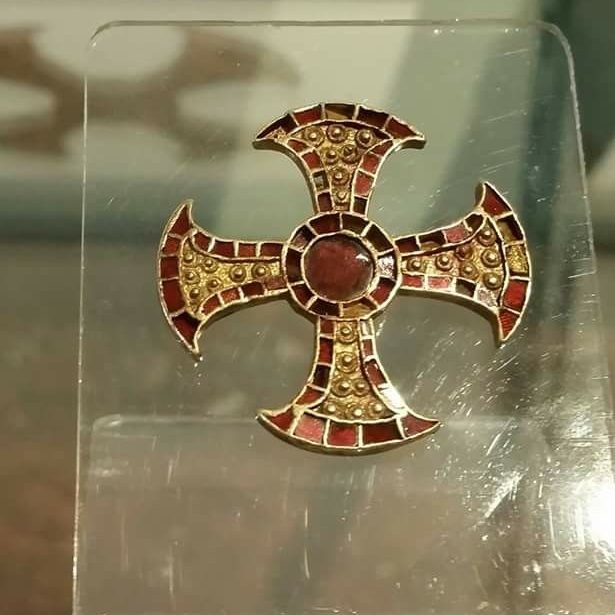
The Trumpington Cross is a gold-and-garnet cloisonné pendant dated to around 650–680 CE, discovered in the remarkable Anglo-Saxon bed burial at Trumpington Meadows, Cambridgeshire. The cross is small, exquisitely crafted, and constructed in the form of a cross pattée with a central roundel. Its front face is decorated with almandine garnets set in gold cloisons, beneath which patterned gold foils were placed to create the characteristic shimmering effect seen in high-status early medieval metalwork. The raised gold bosses on the arms demonstrate sophisticated metalworking techniques, while the plain back, equipped with soldered loops, confirms that the artefact was worn as a pendant rather than mounted. Its craftsmanship aligns with elite workshops active in seventh-century Kent and East Anglia, sharing technical and stylistic traits with objects from Sutton Hoo, Canterbury, and the Prittlewell princely burial.
The context of discovery is essential for understanding the cross’s significance. The young woman buried with it – approximately 16 to 18 years old – was laid to rest on a wooden bed, a rare and high-status funerary practice in Anglo-Saxon England. Fewer than twenty bed burials are known, and those that survive are strongly associated with elite women and early Christian identity. The cross was found on the woman’s chest, indicating that it had been worn in life or deliberately placed to signal her religious affiliation. The grave goods ensemble and the bed construction suggest a person of considerable social rank. Comparable burials, such as those at Street House in North Yorkshire, Barkway, and Coddenham, also contained Christian symbols associated with elite women, placing the Trumpington burial within a broader pattern of socially prominent female engagement with early Christianity.
The cross belongs to the generation following the Christianisation of East Anglia. By the mid-seventh century, the East Anglian royal family and its dependants had increasingly embraced Christianity, supported by missionary activity from Canterbury and the continent. The ornamental language of the cross is deeply rooted in indigenous elite aesthetics; garnet cloisonné had long been used in weapon fittings and high-status male regalia. Its reuse here to express Christian symbolism illustrates how new religious identities were often articulated through existing artistic traditions. While the cross marks the adoption of a distinctively Christian symbol, the craftsmanship reflects continuity with pre-Christian aristocratic visual culture, showing how conversion-era communities adapted older forms to communicate new ideological commitments.
Worn on the body, the cross functioned as an explicit emblem of Christian identity. Contemporary textual sources suggest that elite women played a central role in the establishment and maintenance of Christian households and devotional practice. Bede describes prominent Christian women who shaped early ecclesiastical culture, and other sources, such as the Vita Wilfridi, refer to the gifting of Christian ornaments in aristocratic circles. In this context, the Trumpington Cross may have served not only as a personal devotional object but also as a marker of status and participation in newly forming ecclesiastical networks. Its presence within a richly furnished burial reflects the complex interplay of traditional funerary rites and emerging Christian ideals at a moment when burial customs had not yet fully aligned with ecclesiastical prescriptions.
Interpreting the identity of the Trumpington woman remains speculative, but the evidence points toward someone of elevated status, perhaps connected to royal or aristocratic households involved in the early development of Christian institutions. The proximity of Ely, founded by the royal woman Æthelthryth around 673, raises the possibility of ties to such religious communities. The cross, in this reading, may signal baptismal identity, preparation for a religious vocation, or affiliation with a Christianised lineage. Its combination of luxurious material, high craftsmanship, and explicit Christian symbolism makes it one of the most important artefacts for understanding the intertwining of religious and social transformation in seventh-century England.
 Medieval Letters
Leave a comment