Modern feminism often mistakes sexual desirability for equality: a politics that claims to empower all bodies by insisting they can all be objects of attraction, rather than by decoupling worth from desire altogether.
The Mirror Has Not Shattered
In the age of body positivity, empowerment often looks suspiciously like desirability. Every call to “love yourself” still seems to end in a mirror – a pose, an angle, a softened light. We keep telling women they’re beautiful in every shape, colour, and size, but rarely that beauty might not be the point.
Modern feminism hasn’t escaped the politics of fuckability; it’s simply diversified it. Instead of dismantling the system that judges women by their surfaces, we’ve expanded its membership. Liberation is framed not as freedom from the gaze, but as a broader invitation into it.
A Feminist Paradox
Campaigns for inclusion – from Dove’s “Real Beauty” billboards to Instagram’s #bodypositive grid – promise empowerment, but often reproduce the same aesthetic logic they seek to resist. Desirability becomes virtue. Self-love becomes a visual performance. The camera remains the judge.
Inclusivity has become an aesthetic category, not an ethical one. The problem isn’t that empowerment is sexy, but that it’s still packaged through the same visual grammar as the adverts it critiques. Sensual confidence is marketed as moral good; visibility stands in for liberation.
The feminist message shifts, but the structure does not: the body is central, the gaze inevitable, the politics sold through the same glossy apparatus. This is empowerment as commodity – a sensation, a posture, a brand.
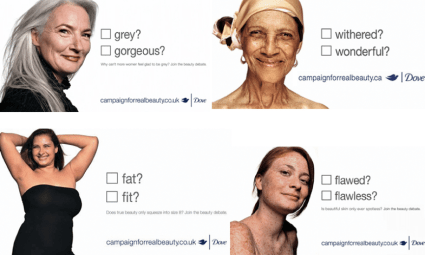
Dove’s Real Beauty campaign
A Medieval Echo: Beauty as Virtue
The strange thing is how familiar this logic is. Medieval Europe, too, treated beauty as a moral index – though the direction of judgment was reversed. Physical appearance reflected inner virtue or sin.
Hildegard of Bingen and Christine de Pizan wrote of feminine beauty as an external sign of divine order. Medieval sermons depicted ugliness as moral deformity, associating disobedience or spiritual corruption with monstrous bodies. Courtly love poetry elevated the beloved woman’s beauty as the emblem of her moral and social superiority.
In a strange reversal, contemporary feminism repeats a medieval logic: the idea that beauty signals virtue – only now, we insist that everyone must have it. Where the Middle Ages moralised beauty to police women, we moralise beauty to praise them. Both systems conflate appearance with goodness.
The Aesthetic Capitalism of Empowerment
The body-positive movement does not abolish desirability; it rebrands it. Empowerment becomes a visual performance – sensual confidence staged as political virtue. Instagram feeds, fashion ads, and wellness influencers sell belief through bodily display: conviction as contour, empowerment as image.
Like historical dramas that turn “authenticity” into a commodity, modern feminism often turns empowerment into an aesthetic. Confidence is curated, stylised, and monetised. The rhetoric might be radical, but the visual logic remains capitalist: the body as product, empowerment as moodboard.
We consume feminist aesthetics the way we consume any other lifestyle: scrollable, purchasable, endlessly reproducible. Beauty is no longer the enemy – but it still governs the terms.
It’s not that beauty is bad, but that we’ve mistaken its expansion for liberation. A world where everyone is beautiful is still a world where beauty decides who matters. The politics of fuckability have not vanished; they’ve become more inclusive, more marketable, more diffuse. What feminism has expanded, it has not yet dismantled.
Perhaps the real feminist revolution isn’t to broaden fuckability, but to outgrow it – to imagine a world in which worth is not a visual category at all. Until then, we remain caught between desire and display, trapped in a mirror that keeps reshaping itself but never fully breaks.
Want to Read More?
- Bordo, Susan. Unbearable Weight: Feminism, Western Culture, and the Body. University of California Press, 1993.
- Gill, Rosalind. “Postfeminist Media Culture: Elements of a Sensibility.” European Journal of Cultural Studies, 10.2 (2007): 147–166.
- Wilson, Elizabeth. Adorned in Dreams: Fashion and Modernity. Rutgers University Press, 2003.
- Dinshaw, Carolyn. Getting Medieval: Sexualities and Communities, Pre- and Postmodern. Duke University Press, 1999.
- Mulvey, Laura. “Visual Pleasure and Narrative Cinema.” Screen 16.3 (1975): 6–18.
 Medieval Letters
Leave a comment