One of the first things you learn when studying the medieval past is that most of it is missing.
Not missing in the dramatic sense alone — not only lost libraries or burned archives — but missing quietly, structurally, and persistently. Roofs rot. Wood disappears. Textiles decay. Bodies return to soil. Villages shift or vanish. People live entire lives that leave behind almost nothing we would instinctively recognise as historical evidence.
And yet medieval archaeology has often been written as though survival were the norm and absence the problem: something to be overcome by better excavation, improved methods, or future discoveries.
This piece argues the opposite. Absence is not a failure of medieval archaeology, but one of its most meaningful forms of evidence. What does not survive — and, crucially, why — tells us as much about medieval society as what does. In the early and high Middle Ages especially, absence is rarely accidental. It is shaped by power, belief, environment, and long-term historical change. To read the medieval past well, we have to learn how to read what is not there.
The medieval world was not built to last — in the way we expect
One of the most persistent assumptions modern readers bring to the Middle Ages is that importance correlates with durability. We expect significant societies to leave behind stone cities, monumental architecture, and dense material remains. When these are missing, absence is easily interpreted as evidence of cultural poverty, instability, or marginality.
This expectation fits poorly with early medieval realities.
Much of early medieval life unfolded in materials that do not survive well, rather than in forms designed for architectural permanence. Timber, earth, and organic matter were widely used not because medieval societies rejected durability as a value, but because these materials were abundant, adaptable, and suited to social and political systems that prioritised mobility, flexibility, and personal authority over fixed infrastructure.
Elite halls, for example, were commonly built of wood and could be repaired, rebuilt, or relocated within a generation. Roofs were thatched; boundaries were marked with banks, ditches, hedges, or shared memory rather than stone walls. Even high-status residences were often less concerned with long-term visibility than with functioning as spaces of gathering, lordship, and display in the present.
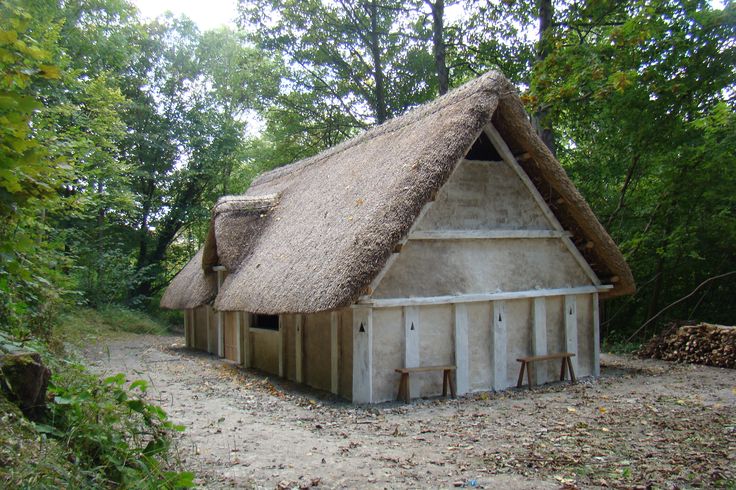
West Stow Anglo-Saxon Village. The Anglo-Saxon Hall House. West Stow Country Park, construction begun 2015; opened October 2016.
When archaeology reveals only post-holes, shallow foundations, or soil discolorations, it is tempting to read these traces as signs of deficiency. In reality, they reflect a society in which architectural permanence was unevenly distributed, reserved for particular institutions — such as churches or, later, fortifications — rather than treated as a universal priority. Absence here does not signal failure, but a different relationship between power, space, and material survival.
When texts promise what archaeology does not deliver
Medieval archaeology is often read against written sources that appear more confident, more detailed, and more precise. Charters describe churches we cannot locate. Chronicles mention settlements that leave little or no material trace. Saints’ lives situate miracles in landscapes that now seem archaeologically silent. It is tempting to treat these gaps as failures of the material record, as though archaeology has simply not yet “caught up” with the texts.
But this assumes that medieval writing aimed to describe physical reality in the way modern documentation does.
Early medieval texts frequently functioned performatively rather than descriptively. A church named in a charter may have been architecturally modest, temporary, or repeatedly rebuilt; what mattered was its legal, spiritual, or commemorative role. Place-names anchored claims to land and authority even when material investment was minimal. Hagiography, in particular, created sacred geographies whose significance did not depend on durable structures or monumental remains.
The absence of expected buildings does not necessarily undermine the text. Instead, it reminds us that written sources and material remains record different kinds of reality, each shaped by its own conventions, priorities, and forms of meaning.
Christianisation and the production of absence
Some medieval absences are the result of long-term decay. Others reflect moments of deliberate intervention.
The spread of Christianity across early medieval Europe did not simply add new buildings and objects to the landscape; it also involved the reworking, suppression, and reuse of existing sacred sites. Archaeologically identifiable pre-Christian cult places are often scarce not because such practices were marginal, but because they were frequently overwritten by later activity or dismantled as part of conversion processes.
This does not mean that every absence signals violent destruction. Christianisation was uneven, locally negotiated, and often gradual. Older ritual practices were sometimes adapted rather than erased. Yet where absences cluster — particularly in regions known from written sources to have experienced reform or ecclesiastical consolidation — they may point to deliberate efforts to reshape religious memory.
In this context, absence should not be read simply as a lack of belief, but as evidence of religious change, conflict, and reinterpretation.
Whose lives leave traces?
The medieval archaeological record is uneven not only because of preservation, but because of social structure.
Stone churches, monasteries, elite residences, and later castles survive disproportionately well, while the material traces of most people’s lives remain faint. This imbalance does not reflect the relative importance of these groups, but the unequal distribution of resources, labour, and commemorative practices.
Most early medieval people lived and worked in ways that left limited durable material: agricultural labour, food preparation, textile production, animal care, and seasonal movement. Much of this activity relied on organic materials and domestic spaces rarely built to endure. Absence here does not indicate that these lives mattered less, but that archaeological visibility closely follows social power.
Recognising this allows us to read the record more critically, rather than mistaking silence for insignificance.
Landscapes of loss
Absence is also produced by time and environment.
Large portions of the medieval archaeological record have been destroyed by erosion, flooding, agricultural change, and later development. Coastal settlements have been lost to the sea; river valleys have been repeatedly reworked; shallow sites have been ploughed flat. What survives today reflects not only medieval activity, but centuries of post-medieval transformation.
This uneven survival has interpretive consequences. Regions with better preservation can appear more densely populated or culturally active, while areas of heavy loss risk being characterised as marginal or underdeveloped. Absence here reminds us that preservation is not a proxy for historical importance. The archaeological map is shaped as much by environmental history as by medieval society itself.
Reuse, reworking, and the logic of survival
Not everything absent from the medieval archaeological record is gone by accident. Much of it was used too well to be buried.
In early and high medieval societies, material objects — especially those requiring specialised labour or scarce resources — were rarely disposable. Metal circulated continuously. Weapons, tools, fittings, jewellery, and coinage were repaired, reshaped, melted down, and remade across generations. Their absence from the ground often signals value rather than neglect.
A sword, for instance, represented a substantial investment of skill and material. Iron was costly to produce; smithing expertise was limited; and weapons retained both practical and symbolic importance long after their original owners died. In many contexts, burying such an object would have been economically irrational. A blade might be reforged, inherited, or repurposed rather than placed in a grave where it would cease to function.
This has important implications for how burial evidence is read. The absence of weapons does not necessarily indicate a peaceful society, nor does it imply that martial identity was unimportant. It may instead reflect a cultural logic in which weapons belonged to the living rather than the dead.
The same principle applies more broadly. Architectural stone was reused; metal fittings scavenged; buildings dismantled for materials; coins clipped, melted, or restruck. Even sacred objects could be reworked, their material continuity outlasting their original meaning. Archaeological absence, in these cases, is the product of continuous circulation, not disappearance.
Absence as movement, not loss
When objects fail to appear in excavated contexts, it is tempting to assume they never existed. But medieval material culture often moved laterally rather than vertically into the archaeological record. Items circulated through hands, workshops, and sites instead of settling into stable depositional contexts.
The longer an object remained useful, the less likely it was to become archaeologically recoverable. Absence here marks successful integration into economic and social systems, not invisibility. In many cases, societies with fewer surviving artefacts were not materially poorer, but more efficient in reuse, repair, and redistribution.
Recognising this shifts how absence is interpreted. A missing sword may point to inheritance practices; a lack of grave goods to economic rationality; an absence of metal to efficient recycling rather than decline. Absence becomes a trace of continuity rather than loss — evidence of what medieval people chose to keep in circulation, and what they were willing to let go.
Want to Read More?
- Wickham, Chris. Framing the Early Middle Ages: Europe and the Mediterranean, 400–800. Oxford University Press, 2005.
- Halsall, Guy. Early Medieval Cemeteries: An Introduction to Burial Archaeology. Edinburgh University Press, 1995.
- Geary, Patrick J. Phantoms of Remembrance: Memory and Oblivion at the End of the First Millennium. Princeton University Press, 1994.
- Olivier, Laurent. The Dark Abyss of Time: Archaeology and Memory. AltaMira Press, 2011.
- Bradley, Richard. The Past in Prehistoric Societies. Routledge, 2002.
 Medieval Letters
Leave a comment