
7 minutes
Quick Facts
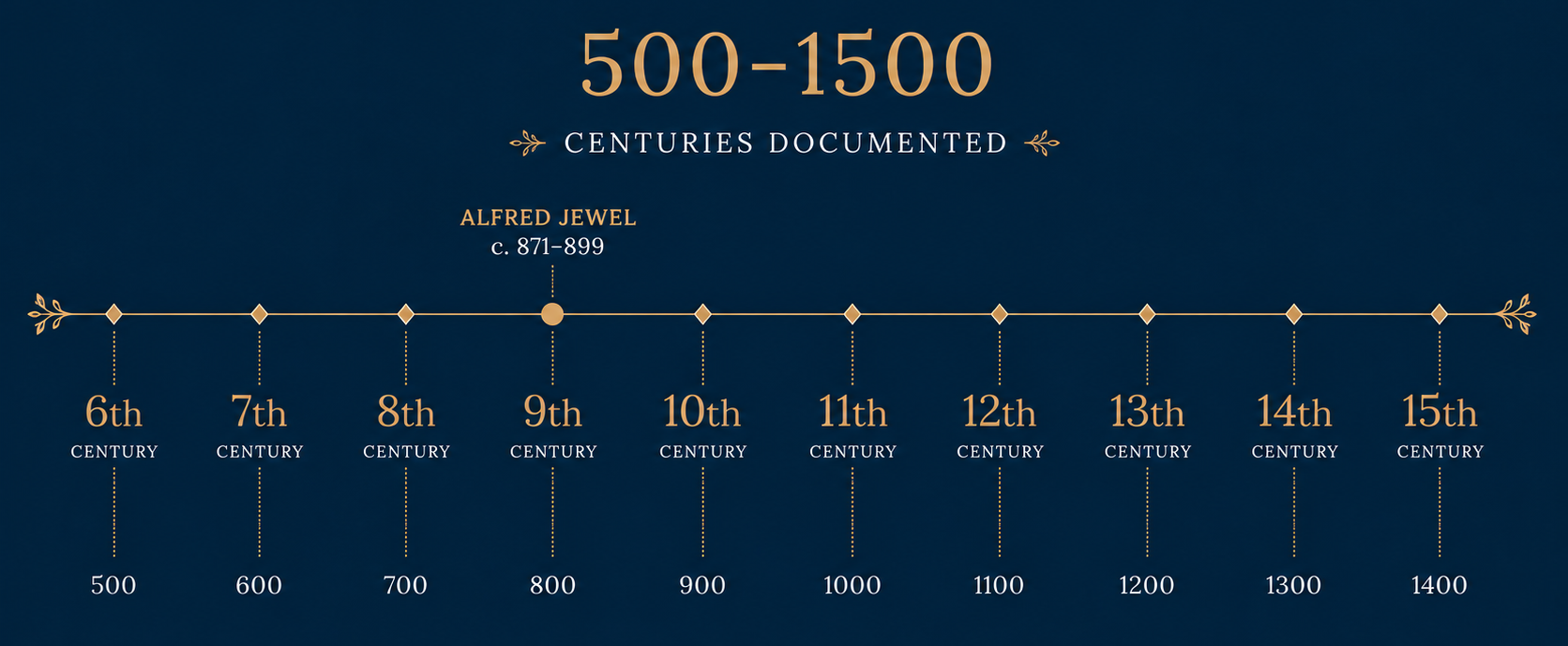
- Date: Late 9th century (c. AD 871–899)
- Origin: North Petherton, Somerset, England
- Culture: Anglo-Saxon (West Saxon court of King Alfred the Great)
- Material: Gold, cloisonné enamel, polished rock crystal, and a bronze/iron rivet with a hollow animal-head socket
- Current Location: Ashmolean Museum, Oxford, England
Introduction
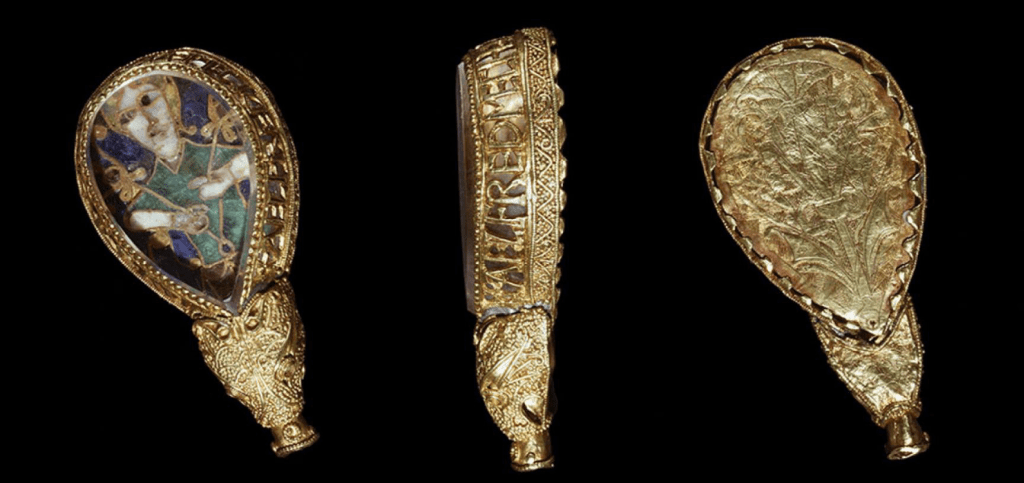
Few artifacts from early medieval England marry elite patronage, exquisite craftsmanship, and intellectual history quite like the Alfred Jewel. Discovered in 1693 in North Petherton, Somerset, near the marshland stronghold of Athelney where King Alfred famously rallied against Viking forces, this tear-shaped masterpiece is inscribed with an unambiguous royal command: AELFRED MEC HEHT GEWYRCAN (“Alfred ordered me to be made”). Beyond its shimmering gold filigree and cloisonné enamel, the jewel offers a tangible window into the ninth-century educational reforms and intellectual revival championed by the West Saxon court. When royal authority increasingly depended upon literacy and learning, what object could embody a Christian king’s vision of knowledge? This article explores the jewel not merely as a decorative trinket, but as a sophisticated instrument of royal ideology and textual culture.
Description
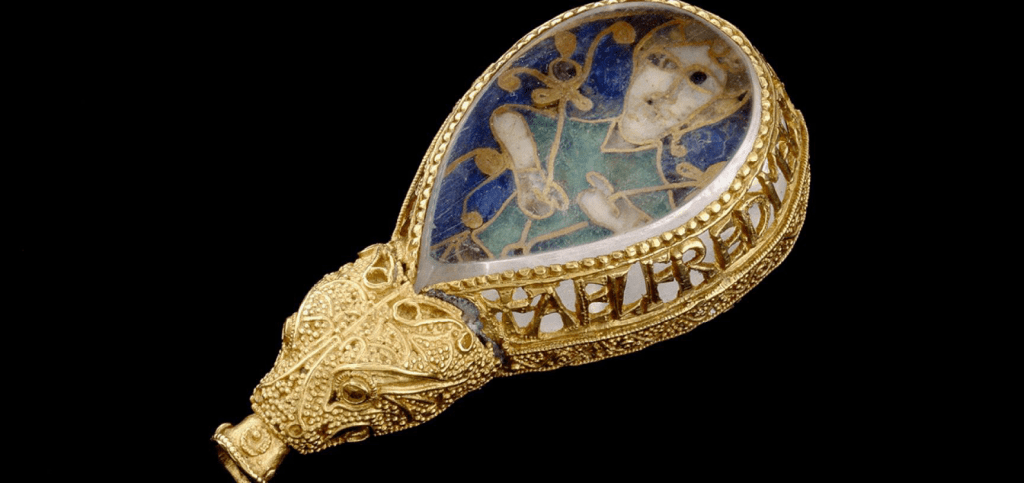
Measuring just over six centimeters in length, the Alfred Jewel is an intricate triumph of Anglo-Saxon metalworking. The object is centered around a highly polished, tear-shaped slice of rock crystal, which acts as a magnifier and protective cover for an enamelled plaque beneath. This plaque depicts a half-length, green-robed human figure with large, expressive eyes, holding two plant-like scepters or flowering stems. Unlike many Anglo-Saxon treasures, the Alfred Jewel was designed to be handled as much as admired.
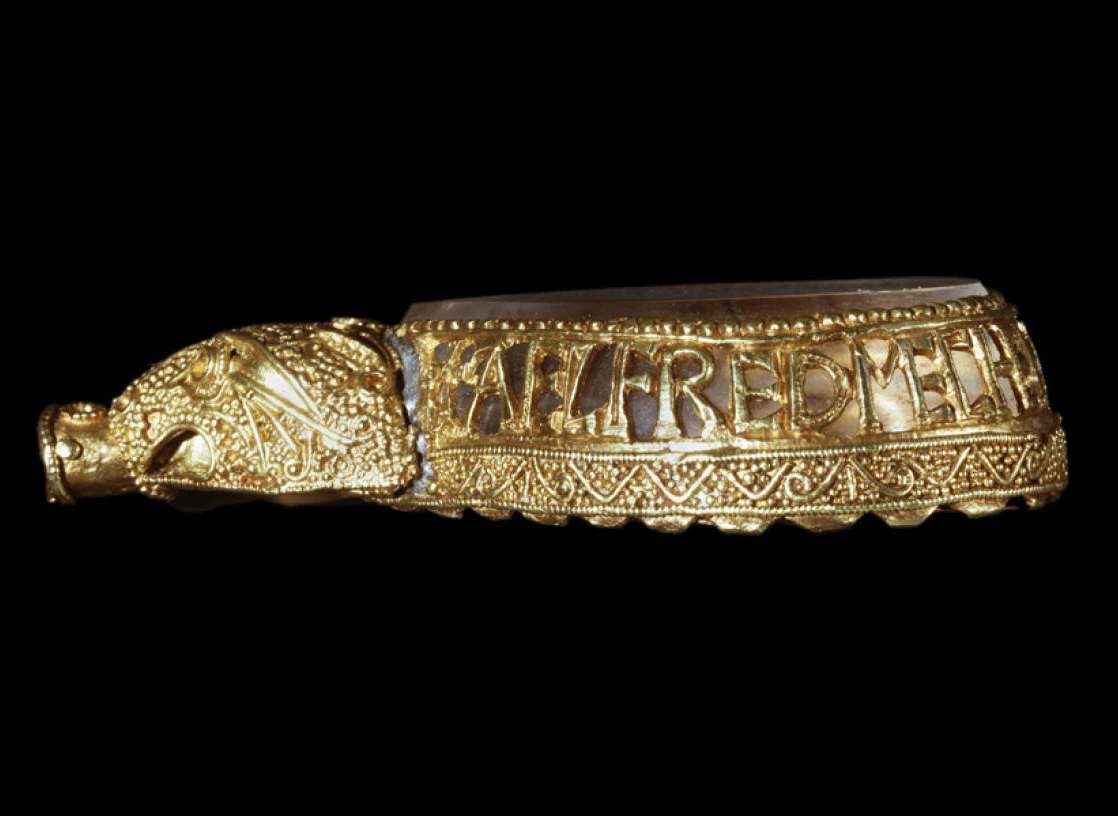
Viewing the jewel in profile reveals the sophisticated interplay of structure, text, and metallurgy that defines its construction. Running along the upper sloping golden rim is the famous openwork inscription executed in pierced capital letters: AELFRED MEC HEHT GEWYRCAN (“Alfred ordered me to be made”). This pierced lettering allows the pale background matrix to show through, ensuring the royal commission is proclaimed with maximum visual clarity. Beneath the inscription lies an exquisite lower border of delicate filigree and granulation work. The profile further highlights the transition from the tear-shaped crystal down to the stylized animal head, whose snout forms a hollow cylindrical socket designed to receive a wooden or ivory pointer rod. This side angle demonstrates that the object was engineered not as a flat pendant, but as a three-dimensional handle meant to be mounted and viewed in profile, where text, animal iconography, and precious media converge into a single royal instrument.
Object Biography: From Courtly Creation to National Icon
The biography of the Alfred Jewel spans over a millennium of manufacture, use, loss, and reinterpretation. It began its life in a late ninth-century West Saxon workshop, forged under royal patronage as a luxury handle for a precious manuscript pointer. In its original ecclesiastical or courtly context, it was actively used to turn pages and guide the eye during the solemn reading of vernacular translations. At some point following the collapse of the Anglo-Saxon kingdom or during subsequent turmoil, the organic rod perished and the jewel was lost, slipping into the Somerset soil near North Petherton.
For centuries it lay buried until agricultural ploughing revealed it in 1693, bringing it into the orbit of early modern antiquarians who recognized its royal significance. Its subsequent donation to the Ashmolean Museum in Oxford in 1718 transformed it from a forgotten medieval tool into a foundational relic of English national heritage. Today, its journey from royal scriptorium to museum showcase makes it one of the most recognizable and enduring symbols of early English intellectual history.
Historical Context: Alfredian Educational Reform
The jewel dates to the late ninth century (c. AD 871–899), a tumultuous yet intellectually vibrant era under King Alfred the Great. Following his critical victory over the Viking Great Army at Edington in 878, Alfred embarked on an ambitious program of cultural and religious renewal. Lamenting the severe decline of Latin literacy and theological learning across England, Alfred sponsored the translation of key foundational texts – such as Pope Gregory the Great’s Pastoral Care – into Old English. In the famous preface to the Pastoral Care, Alfred noted that he would send a copy of the translated book to every bishopric in his kingdom, accompanied by an æstel (a precious pointer or book-marker) valued at fifty mancuses.* The Alfred Jewel is widely believed to be one of these elite book-pointers.
*In ninth-century terms, the valuation of fifty mancuses represented an extraordinary financial investment. A single mancus–roughly equivalent to a month’s wages for a skilled artisan –meant that fifty mancuses equaled several years of specialized labor, making each æstel a priceless royal gift that underscored the immense political and spiritual capital Alfred invested in his educational renaissance.
Analysis: Performing Literacy and Divine Wisdom
The primary scholarly consensus regarding the jewel’s function identifies it as the handle of an æstel, a ceremonial pointer used to guide the eye along lines of text in prestigious manuscripts. However, viewing the object solely as a reading aid overlooks its deeper ideological role. An Alfredian æstel demonstrates that reading itself was becoming a deliberate political act. In a society where royal authority was increasingly anchored in textual administration and vernacular literacy, the act of following sacred prose with a glittering, gold-and-rock-crystal pointer transformed study into performance.
Furthermore, the central enamelled figure under the rock crystal has generated profound debate. While earlier antiquarians interpreted the image as St Cuthbert or Christ in Majesty, modern art historians like Leslie Webster suggest it represents an allegorical personification of Sight. Such an allegorical motif would be exceptionally fitting for an instrument dedicated to the contemplative act of reading and spiritual illumination. By fusing Byzantine-inspired cloisonné enamel with vernacular royal patronage, the jewel manifests Alfred’s broader project: anchoring political survival in divine wisdom and literate governance.
Why Scholars Still Disagree
Despite its iconic status, the Alfred Jewel remains a subject of lively academic debate across several fronts:
- Is it definitely an æstel? While the book-pointer hypothesis is widely accepted, alternative theories have suggested it served as the apex ornament of a crown, a staff finial, or a high-status pendant (though hanging it as a pendant would render the enameled figure upside down).
- Who does the enamel figure represent? Scholars remain divided between reading the robed figure as Christ as Wisdom, Christ in Majesty, a personification of Sight, or even King Alfred himself in divine guise.
- What was the exact nature of an æstel? Because Old English textual evidence for the word æstel is extremely scarce outside Alfred’s preface, its precise material form and ritual use in the scriptorium remain open to philological dispute.
- Was the rock crystal reused? The unusual tear-shaped quartz may be a recycled Roman or Migration-period gem mounted into a newly commissioned ninth-century West Saxon setting.
These ongoing debates highlight how a single small artifact can sustain diverse methodological approaches spanning archaeology, art history, and philology.
Legacy
Small enough to fit in the palm of a hand, the Alfred Jewel nevertheless embodies one of the most ambitious cultural programmes of the early Middle Ages: the conviction that books, learning, and material beauty could rebuild a kingdom. As a cornerstone of the Ashmolean Museum’s collections, it continues to inspire new generations of scholars exploring the intricate intersections of royal power, material culture, and literacy in pre-Conquest Britain.
Further Reading
- Hinton, David A. A Catalogue of the Anglo-Saxon Ornamental Metalwork 700–1100 in the Department of Antiquities, Ashmolean Museum. Oxford: Clarendon Press, 1974.
- Webster, Leslie. Anglo-Saxon Art. London: British Museum Press, 2012.
- Wilson, David M. Anglo-Saxon Art: From the Seventh Century to the Norman Conquest. London: Thames and Hudson, 1984.
- Keynes, Simon, and Michael Lapidge, trans. Alfred the Great: Asser’s Life of King Alfred and Other Contemporary Sources. London: Penguin Books, 1983.

