
7 minutes
Quick Facts
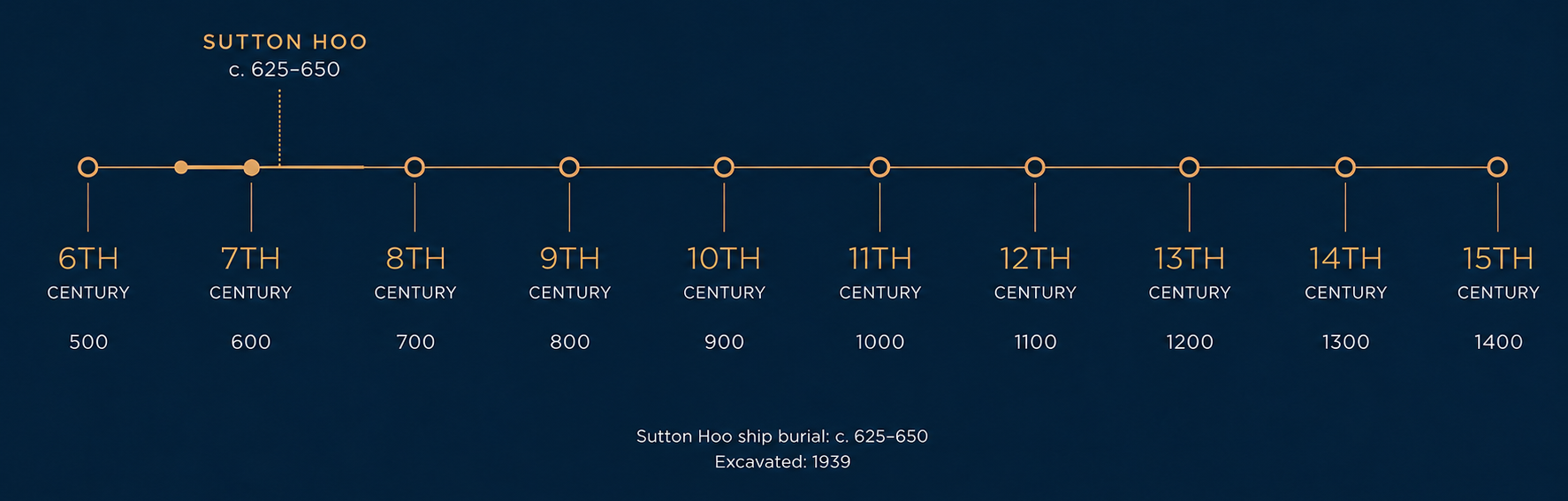
- Date: c. AD 625
- Origin: Sutton Hoo Mound 1, Woodbridge, Suffolk, England
- Culture: Anglo-Saxon (East Anglian kingdom) / Vendel Period Germanic
- Material: Sheet-iron body, tinned bronze pressblech foils, silver wire inlay, almandine garnets, and leather/textile lining
- Current Location: The British Museum, London* as of July 2026
- Category: Crested mask-helmet / Royal funerary regalia
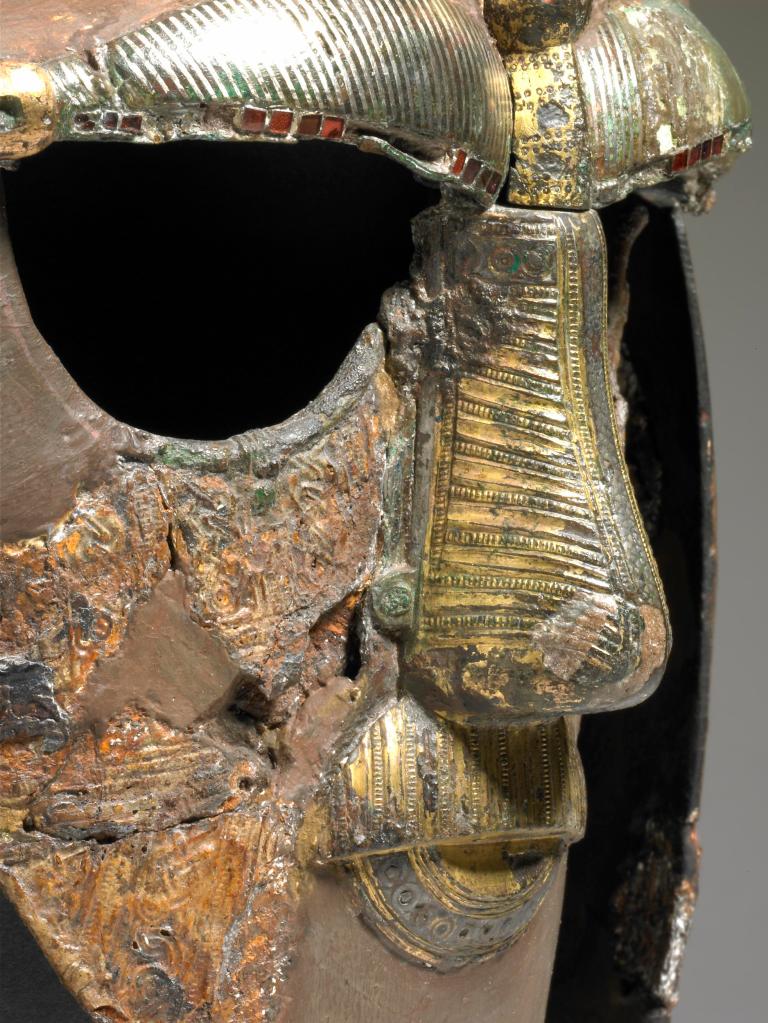
A close examination of the facial mask reveals the extraordinary intricacy of these decorative elements. The eyebrows gleam with meticulously fitted cloisonné almandine garnets, while the gilded bronze nose and mustache form the wings and body of a soaring dragon . The pitted, oxidized iron plates surrounding the eye sockets contrast sharply with the polished gold and silver elements, highlighting both the antiquity of the crushed fragments and the stunning precision of the metalwork.
Introduction
Few artifacts encapsulate the material splendor and complex ideological landscape of early medieval England quite like the Sutton Hoo helmet. Unearthed from the Mound 1 ship burial in Suffolk in 1939, this remarkable piece of defensive equipment transcends mere military utility. It serves as a potent political statement and a window into the aristocratic networks of the North Sea world during the early seventh century. As scholars examine the interconnected cultures of Anglo-Saxon England and Scandinavia, the helmet remains a central monument in discussions of kingship, craft production, and pre-Christian Germanic ritual. When power is unwritten and political authority rests on performance, what does a king’s face look like? This article examines the helmet not merely as a passive museum exhibit, but as an active agent in the construction of early medieval kingship.
Object Biography: From Iron and Garnet to Museum Icon
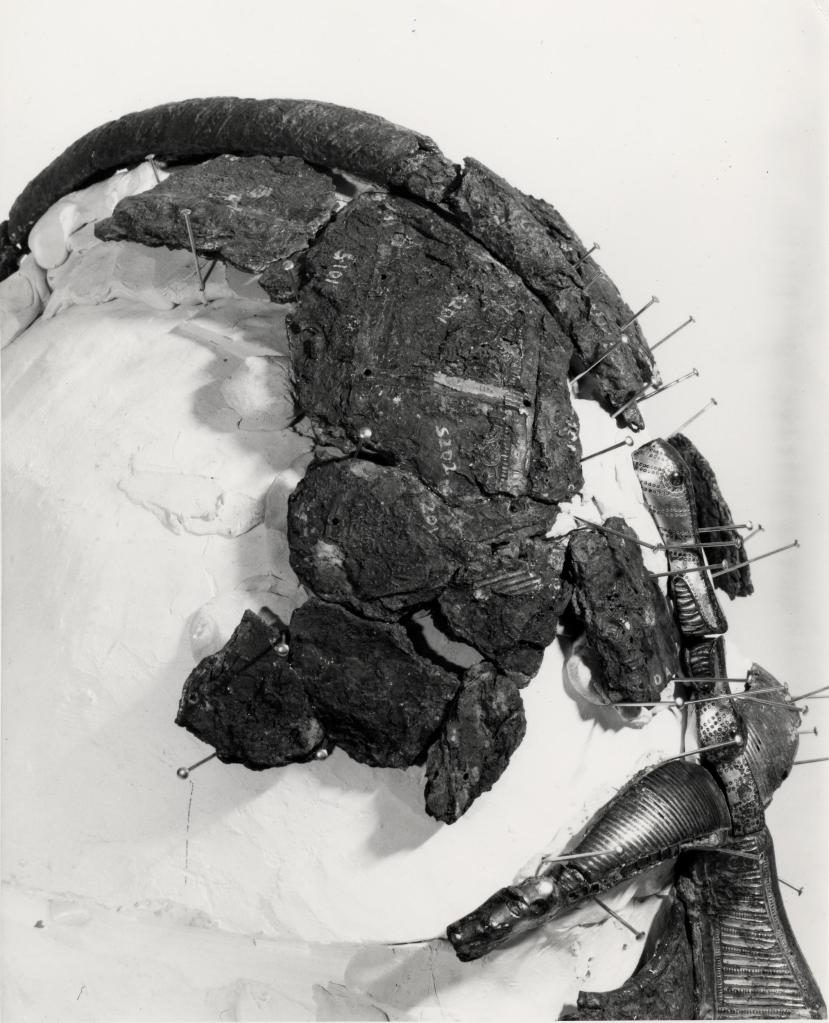
The physical existence of the Sutton Hoo helmet is a story of destruction, fragmentation, and painstaking reconstruction. When the burial chamber’s timber roof collapsed under the immense weight of the earthen mound in the seventh century, the helmet was crushed and shattered into more than five hundred tiny, corroded iron and gilded bronze fragments. When excavated by Basil Brown in 1939, it appeared as an unpromising, rusted mass. Its subsequent biography is inseparable from modern conservation history. Herbert Maryon undertook the first reconstruction at the British Museum in 1945 and 1946, embedding fragments in plaster and producing an iconic image that graced countless textbooks for decades.
However, scholarly discomfort with anatomical improbabilities in Maryon’s model prompted a radical reassessment. Between 1970 and 1971, young conservator Nigel Williams completely dismantled the helmet, reducing it back to its constituent fragments to solve the jigsaw puzzle anew. This second reconstruction revealed new joins by analyzing the blackened, rippled organic residue of the deteriorated leather lining preserved on the backs of the metal pieces. This methodological shift reminds us that the object we admire today is mediated by twentieth-century restoration techniques, transforming a shattered archaeological deposit into a coherent symbol of royal power.
Historical Context and the North Sea Elite
Dated to approximately AD 625, the Sutton Hoo ship burial belongs to a period of intense political consolidation in Anglo-Saxon England. The East Anglian kingdom was rising to regional prominence under the Wuffingas dynasty, with King Rædwald frequently cited as the most probable occupant of the grave. Rædwald occupied a complex religious and political liminal space, famously maintaining a Christian altar alongside a pagan shrine as recorded by Bede. The material culture of the burial reflects this aristocratic milieu, demonstrating widespread exchange networks across the North Sea. The helmet is part of an exclusive corpus of crested helmets from the Migration and Vendel periods, sharing deep typological ties with high-status finds from Vendel and Valsgärde in Uppland, Sweden. These artifacts point to shared ideological frameworks among Germanic elites, where military equipment served as a primary medium for expressing heroic values, divine protection, and ancestral lineage.
Analysis: Political Theatre and Divine Personification
The iconography and technical sophistication of the Sutton Hoo helmet offer profound insights into early medieval metalworking and worldview. Stylistically, the helmet belongs to a tradition rooted in Late Roman cavalry and infantry parade helmets, transformed by Germanic artisans into elaborate symbols of chieftainly authority. The pressblech panels depict standardized motifs, such as the rider motif where a mounted warrior tramples a fallen opponent while a smaller attendant guides his spear. This scene is widely interpreted as a depiction of Woden (Odin) and his chosen warriors. Furthermore, recent scholarship by archaeologists Neil Price and Paul Mortimer highlights subtle asymmetries in the helmet’s design, such as the deliberate omission of reflective gold foil beneath one eye of the crest and eyebrow. This intentional design feature suggests that the wearer was meant to evoke the one-eyed war god Odin, blurring the boundary between human ruler and divine patron during rituals within the feasting hall. The inclusion of apropaic animals like boars and dragons further reinforced the protective magic imbued in the armor.
While the Odin interpretation remains speculative, its importance lies less in proving a specific mythological identification than in highlighting how early medieval elites used material culture to construct political legitimacy. When literacy was scarce and political authority was performed in the firelit atmosphere of the mead-hall, physical objects did not merely reflect status; they actively manufactured it.
Why Historians Still Disagree
The enduring fascination of the Sutton Hoo helmet stems from the fundamental ambiguities of its archaeological context. Historians and archaeologists continue to debate several key questions:
- Was it really Rædwald? While King Rædwald remains the leading historical candidate due to the chronology and scale of Mound 1, the absence of written inscriptions leaves open the possibility that the grave belonged to another East Anglian magnate, a member of his royal household, or an even earlier warlord.
- Was it actually worn in combat? The heavy iron construction, integrated face mask, and precious garnet inlays have led some scholars to argue that the helmet was purely ceremonial or a piece of regalia. However, wear analysis and repairs suggest it was a functional, battle-ready piece of armor before its deposition.
- Odin or generic heroic imagery? While the one-eyed motifs and dancing warriors strongly evoke Norse mythology, critics argue that these tropes may represent general heroic ideals shared across Germanic warrior cultures rather than specific cultic worship of Odin.
- Scandinavian import or local masterpiece? Longstanding debates center on whether the helmet was manufactured in Sweden or produced locally in East Anglia by master craftspeople utilizing imported Scandinavian dies and stylistic conventions.
- Burial or cenotaph? Ongoing discussions question whether Mound 1 contained an actual body that completely decayed in the acidic East Anglian soil, or whether it functioned as a symbolic cenotaph honoring a leader lost at sea.
These unresolved debates demonstrate that early medieval archaeology is an ongoing exercise in interpretation, where material evidence must be weighed against shifting historical frameworks.
Legacy
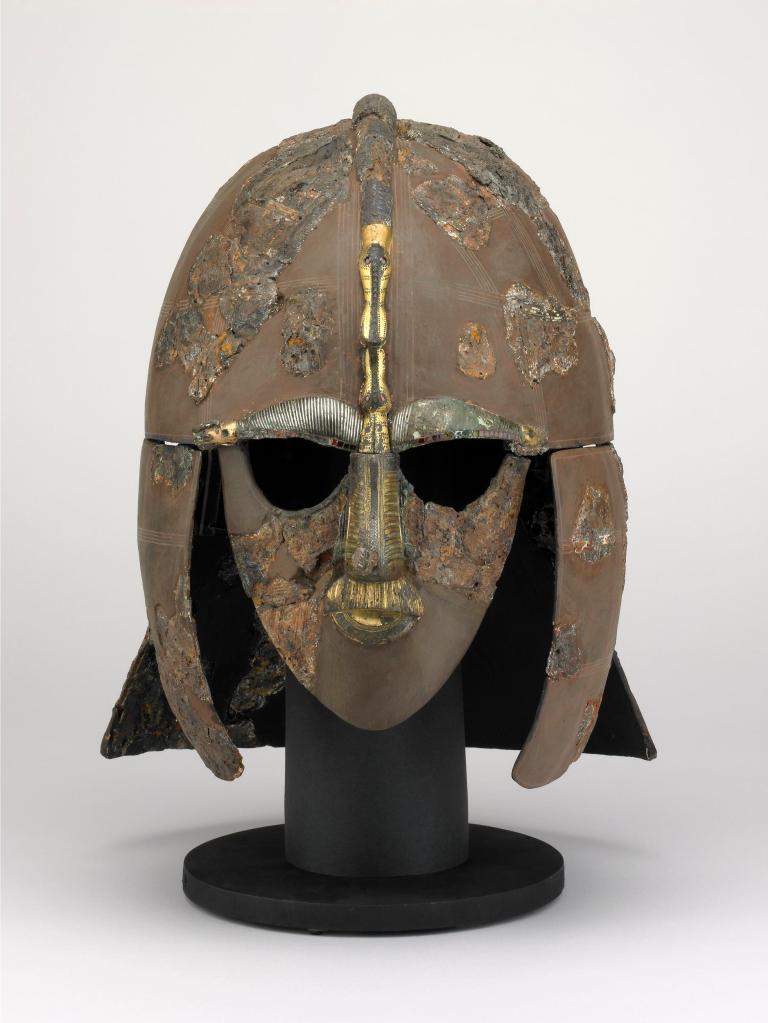
The Sutton Hoo helmet has occupied a central place in the public and academic imagination since its reassembly, becoming an enduring icon of early English archaeology. Housed permanently in the British Museum, its iconic visage has shaped modern visual perceptions of the Anglo-Saxon period. Moreover, the helmet maintains a powerful resonance with vernacular literature, most notably in illuminating the material culture described in the Old English epic Beowulf. By bridging archaeology and literary studies, it continues to inspire interdisciplinary research into early medieval kingship, myth, and material culture.
Further Reading
- Bruce-Mitford, Rupert. The Sutton Hoo Ship-Burial. 3 vols. London: British Museum Press, 1975–1983.
- Marzinzik, Sonja. The Sutton Hoo Helmet. London: British Museum Press, 2007.
- Price, Neil, and Paul Mortimer. “An Eye for Odin? Divine Role-Playing in the Age of Sutton Hoo.” European Journal of Archaeology 17, no. 3 (2014): 517–538.
- Williams, Howard. “The Sense of Being Seen: Ocular Effects at Sutton Hoo.” Journal of Social Archaeology 11, no. 1 (2011): 99–121.
- Williams, Nigel. “The Sutton Hoo Helmet.” In The Art of the Conservator, edited by W. A. Oddy, 73–88. London: British Museum Press, 1992.

